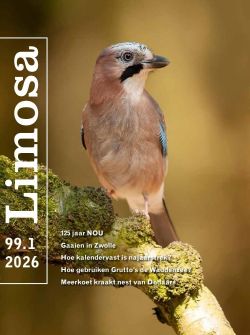
Gerrit J. Gerritsen & Peter van Horssen (2026) Jays in the city: survival, mobility, biometry, moult, food and group courtship behaviour of Jays Garrulus glandarius in Zwolle. LIMOSA 99 (1): 5-14.
With a population of 45-65 000 pairs in 2013-15, Jay is a
common breeding bird in the Netherlands. The species
slowly expanded in the 20th century and in 2013-15 Jay
was breeding in 90% of the country. Highest densities, up
to 15 pairs/km2, are found in mixed forests on fertile soils.
Jay numbers also increased in urban areas, especially in
quarters with an old and diverse vegetation of trees and
shrubs. We studied Jays in the city of Zwolle, in the central
part of the Netherlands. In 2013-15 the Jay population in
Zwolle was estimated at 170-390 pairs on 25 km2, a density
of 6.8-15.6 pairs/km2. This urban habitat thus belongs to the
best breeding habitats for Jay in the Netherlands.
In 1987-2024 a total of 194 Jays were ringed in a garden
in the old quarter ‘Veeralleekwartier’ in Zwolle (Fig. 1).
From 2014 onwards birds were also colour-ringed (N=76).
Based on re-sightings (in total 3329 Jays were checked for
colour rings) the apparent annual survival was estimated to
be 0.62, with no difference between first calendar-year and
older birds (Tab 1). Colour-ring densities varied markedly
between the ringing site (61%), the quarter of the ringing
site (Veeralleekwartier) (47%), and the rest of the city
(3%; Tab. 2). Jays proved to be remarkably site faithful and
thus showed low mobility, presumably a result of the rich
and sufficient food supply in the study area. Qualitative
information about diet was collected during 3400 counts
on the ringing site in the years 2022-25 (Fig. 3). Jays took
fruits and flowers of at least 13 species of trees and shrubs.
Animal food was only recorded incidentally and consisted
of bees, small dragonflies, wasps and snails. Finally, some
data on biometry, weight, primary moult (Fig 2.) and group
courtship behaviour is presented.
[pdf only for members] [dutch summary]
|