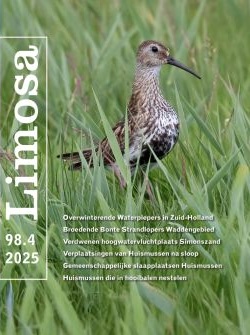
Vasco van der Boon & Jip Louwe Kooijmans (2025) Simonszand: an important high-tide roost for birds in the Dutch Wadden Sea
that disappeared in the sea. LIMOSA 98 (4): 167-178.
The uninhabited sandbank complex Simonszand was
located between Schiermonnikoog and Rottumerplaat
in the Dutch Wadden Sea. It served as an important
high tide roost for migrating and wintering birds. Since
"#$%, "&' high tide roost counts have been carried out
at Simonszand. The last count was in November '(''.
The monitoring stopped because the sandbank had
disappeared in the sea due to the natural dynamic of the
Wadden Sea. Simonszand ful)lled the two quantitative
Ramsar-criteria for an international important bird area.
During %& counts more than '( ((( birds stayed at the
same time at Simonszand. More than "+ of the /yway
population of eight bird species repeatedly stayed at
monszand: Eurasian Oystercatcher, Dunlin, Sanderling,
Red Knot, Grey Plover, Eurasian Curlew, Bar-tailed Godwit
and Common Shelduck.
The total number of individual birds on Simonszand
roughly kept pace with the growth and then the shrinkage
of the sandbank. The number of roosting bird species
responded more slowly to the decrease in the sandbank’s
surface area. The seasonal occurrence of Red Knot and
Common Ringed Plover on Simonszand deviated from
their seasonal occurrence throughout the rest of the
Dutch Wadden Sea.
[pdf only for members] [dutch summary]
|